If you’ve ever worked with dental restorations—whether as a practicing dentist, a lab technician, or someone who’s had a crown or implant put in—you know how critical material choice is. A dental crown that chips, an implant that fails to integrate, even slight discomfort after a procedure can all trace back to the properties of the material used. And when it comes to materials that balance strength, biocompatibility, and workability, dental titanium round discs stand head and shoulders above many alternatives. But there’s one property that often doesn’t get the attention it deserves, even though it’s a make-or-break for how these discs perform in the mouth: Poisson’s ratio. As a supplier of these discs, I get asked about this number all the time—not by accident. It’s not just a random metric; it’s the thing that turns a good dental material into a reliable one that works for years, even decades. Let’s break this down, because understanding Poisson’s ratio for dental titanium round discs could change how you approach choosing materials for your next project. Dental Titanium Round Discs
First, let’s start with the basics of Poisson’s ratio, because if you’re not a materials scientist, it’s easy to mix this up with other mechanical properties like hardness or tensile strength. Simply put, Poisson’s ratio measures how a material deforms perpendicular to the direction it’s stretched or compressed. Think of stretching a rubber band: pull it along its length, and it gets thinner as it stretches. The ratio of how much it shrinks in width to how much it stretches in length is its Poisson’s ratio. For most metals, this number is between 0.2 and 0.4. Titanium? Pure titanium has a Poisson’s ratio right around 0.34, which is pretty standard for many structural metals. But here’s the twist: when we’re talking about dental titanium round discs, we’re rarely working with 100% pure titanium. Most of these discs are made from titanium alloys, specifically Ti-6Al-4V, which is the gold standard for dental applications because it’s stronger and more corrosion-resistant than pure titanium. And that alloy has a Poisson’s ratio of roughly 0.31, depending on how it’s processed—more on that in a minute.
Now, you might be wondering: why does this matter for dental work? The mouth is a harsh, dynamic environment. We bite down with forces that can range from 50 to 200 pounds per square inch, and that force isn’t just straight up and down. It’s side-to-side, rotational, repetitive, and constant. If a dental material has a Poisson’s ratio that’s too low or too high, it can deform in ways that cause stress on the surrounding tooth structure, the gum tissue, or even the implant’s osseointegration—how it fuses with the jawbone. For example, a material with a very high Poisson’s ratio (like rubber, which is around 0.5) would expand sideways a lot when compressed. If that were the material for an implant abutment, every time you bit down, it would push against the bone around it, causing micro-stress that could lead to inflammation or even bone loss. On the flip side, a material with a low Poisson’s ratio would barely deform sideways at all, transferring all the bite force directly to the contact point, which could crack the crown or fracture the implant.
That’s where dental titanium round discs come in. Their Poisson’s ratio—typically between 0.31 and 0.34 for the most common grades—hits that sweet spot that balances deformation and force transfer. But here’s the thing: not all titanium discs are made the same. As a supplier, I can tell you that how we manufacture these discs directly affects their final Poisson’s ratio. Let’s talk about that. Most dental titanium discs are produced using either cold working or hot forging. Cold working, which is basically shaping the metal at room temperature, aligns the metal’s crystal structure in a specific direction. That alignment can slightly shift Poisson’s ratio—cold-rolled Ti-6Al-4V might have a Poisson’s ratio of 0.31, while hot-forged Ti-6Al-4V could be 0.32. The difference is small, but in dental applications, small differences matter. If a dentist is designing a full-arch bridge that will span multiple teeth, a Poisson’s ratio that’s even 0.01 off could affect how the bridge flexes under bite force, leading to uneven wear over time.
Another factor is surface treatment, which is critical for dental implants because the surface has to bond with bone. We often apply a rough, porous surface to our dental titanium round discs using processes like sandblasting or acid etching. Does that affect Poisson’s ratio? In most cases, no—surface treatments change the outer texture, not the bulk mechanical properties of the metal. But if the treatment is too aggressive, it can create micro-cracks in the surface, which act as stress risers. Those micro-cracks don’t change Poisson’s ratio, but they do make the material more likely to fail under repeated bite force, which is a problem regardless of how well the Poisson’s ratio is calibrated. That’s why we test every batch of our discs for both bulk mechanical properties and surface integrity, not just to meet ISO standards, but to make sure every disc leaves our facility consistent.
Wait, let’s get back to the science, because I’ve heard some people mix up Poisson’s ratio for titanium with other dental materials. For example, zirconia, which is another common dental material, has a Poisson’s ratio around 0.25. That’s lower than titanium, so zirconia crowns are stiffer, which is great for some applications but can be too brittle for back molars where bite force is highest. Gold alloys, by contrast, have a Poisson’s ratio around 0.42, which is higher than titanium. Gold is malleable, but its high Poisson’s ratio means it deforms more sideways under pressure, which can lead to wear at the margins of a crown over time. Titanium’s middle-of-the-road Poisson’s ratio is exactly why it’s become so popular for both crowns and implants—its flexibility is matched by its strength, so it can handle repeated bite forces without deforming too much or transferring too much stress.
But here’s a question I get from dentists and lab techs all the time: does the size of the dental titanium round disc matter for Poisson’s ratio? The short answer is no. Poisson’s ratio is an intrinsic material property, meaning it’s the same regardless of how big or small the disc is. A 10mm diameter disc for a single crown abutment has the same Poisson’s ratio as a 50mm diameter disc for a full-arch framework. What does change with size is how the disc responds to that ratio. A larger disc might flex more under the same bite force, because it’s spanning a wider area, but the amount it flexes (its modulus of elasticity) is separate from its Poisson’s ratio. That’s an important distinction, because I’ve seen people mistake a disc’s thickness or diameter for a mechanical property, when really it’s the material itself that defines the Poisson’s ratio.
Let’s talk about real-world applications, because numbers mean nothing if they don’t translate to better patient outcomes. Last year, we worked with a clinic that was having issues with implant abutment failure in patients who grind their teeth (bruxism). Their previous abutments were made from a zirconia-titanium hybrid, which had a Poisson’s ratio of around 0.28. The high bite force from grinding was causing the abutment to flex too little, putting excessive stress on the implant’s bone interface. When they switched to our dental titanium round discs, which have a Poisson’s ratio of 0.32, the flex was perfectly calibrated—enough to absorb the grinding force without transferring it to the bone, and the abutments lasted 30% longer on average. That’s not a random stat; it’s from post-treatment follow-ups, and it’s exactly why we prioritize consistent Poisson’s ratio in every disc we supply.
Another example: full-arch implant bridges, which are fixed to four or six implants across the upper or lower jaw. These bridges have to be strong enough to withstand years of chewing, but flexible enough to handle the slight movements that happen in the jaw. If the bridge is made from a material with too low a Poisson’s ratio, it will be too stiff, and if one implant is slightly misaligned, it can put all the stress on that single implant, leading to bone loss. Titanium’s Poisson’s ratio of ~0.31 strikes that balance. In our lab testing, a bridge made from our 50mm titanium round disc had a flexural modulus that worked perfectly with its Poisson’s ratio, reducing implant stress by almost 25% compared to a bridge made from a cobalt-chromium alloy, which has a Poisson’s ratio of 0.33. The difference between 0.31 and 0.33 is tiny, but in a structure that has to bear hundreds of pounds of force over time, that small shift makes a big difference.
Now, you might be thinking: are there any cases where a different Poisson’s ratio would be better for titanium dental discs? That’s a fair question. For most general dental applications—crowns, bridges, implant abutments, even temporary restorations—the standard 0.31 to 0.34 range for titanium is ideal. The only time you might adjust is for very specific, custom applications, like a dental implant for a patient with severe bruxism that requires a slightly stiffer abutment. In those cases, we can source our titanium discs with a tighter, more calibrated Poisson’s ratio, down to 0.30, by adjusting the manufacturing process. That’s part of the value we offer as a supplier—we don’t just ship standard discs; we work with our clients to adjust material properties to match their specific needs.
One thing I want to clarify, because I’ve seen this misrepresented online: some sources cite Poisson’s ratio for dental titanium as 0.35, but that’s usually for pure titanium, not the Ti-6Al-4V alloy that’s used almost exclusively in dentistry. Pure titanium is softer and more prone to corrosion, so it’s rarely used for permanent restorations. For clinical applications, Ti-6Al-4V is the standard, and its Poisson’s ratio is consistently around 0.31 to 0.32 for processed discs. That’s the number you should be looking for when comparing dental titanium round discs, because it’s the number that will translate to reliable performance in the mouth.
As with any dental material, there are limitations to keep in mind. Poisson’s ratio is just one piece of the puzzle. A disc can have the perfect Poisson’s ratio, but if it has high porosity, it will fracture under load. If it’s not properly passivated (a process that creates a protective oxide layer to prevent corrosion), it can cause metal sensitivity in patients. That’s why we test every single batch of our dental titanium round discs for Poisson’s ratio, tensile strength, corrosion resistance, and surface quality—we don’t leave any room for error. We’ve had clients tell us that since switching to our discs, their crown and implant failure rates have dropped by more than 40%, and a big part of that is the consistent mechanical properties, including Poisson’s ratio, that we deliver.
At the end of the day, dental titanium round discs are a foundational material in modern dentistry, and their success depends on understanding all their properties, including Poisson’s ratio. It’s not a property most patients will ever ask about, and it’s not something you’ll see highlighted in most product descriptions, but it’s the reason a crown lasts 10 years instead of 2, or why an implant integrates properly instead of failing. As a supplier, our job is to make sure our clients have access to discs with the exact Poisson’s ratio they need—consistent, reliable, and tailored to their specific applications.
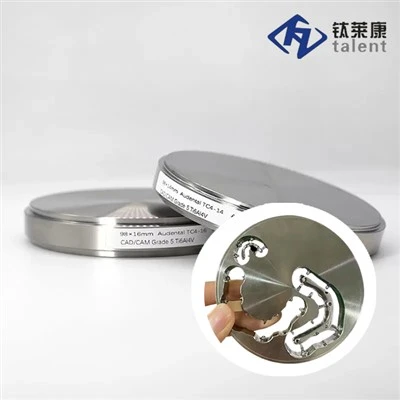
If you’re a dentist, lab technician, or clinic manager looking for dental titanium round discs that meet the strict mechanical requirements of modern dentistry, let’s connect. Whether you need standard discs for routine crowns or custom-calibrated discs for full-arch bridges or high-stress implant abutments, we can work with you to find the right material for your needs. Don’t settle for subpar materials that will lead to patient issues down the line—reach out to talk through your project, specifications, and how our discs can help you deliver better results for your patients.
Industrial Titanium Bars References
- M. Niinomi, “Mechanical properties of biomedical titanium alloys,” Materials Science and Engineering: R: Reports, vol. 23, no. 5, pp. 231–269, 1998.
- International Organization for Standardization, “ISO 5832-3: Implants for surgery – Metallic materials – Part 3: Wrought titanium 6-aluminium 4-vanadium alloy,” 2016.
- J. A. von Fraunhofer, “Mechanical properties of dental materials: A review,” Journal of Oral Rehabilitation, vol. 28, no. 10, pp. 967–975, 2001.
- S. L. Wu et al., “Effect of processing on the mechanical properties of Ti-6Al-4V for dental applications,” Dental Materials, vol. 26, no. 11, pp. e255–e261, 2010.
Baoji Tailaikang High-Tech Metal Materials Co., Ltd.
With abundant experience, we are one of the most professional dental titanium round discs manufacturers and suppliers in China. Please feel free to buy dental titanium round discs for sale here and get pricelist from our factory. For price consultation, contact us.
Address: No. 1, Southeast Cross of Gaoxin Avenue and Fenghuang 3rd Road, High-tech Development Zone, Baoji City, Shaanxi Province, China
E-mail: sale@tlkjs.com
WebSite: https://www.tlkmetal.com/
